

Plants can’t get COVID-19, but they can get infected by a range of other viruses. Some of those viruses can cause huge problems for crops. A ringspot virus, for instance, threatens papaya fruit trees in Taiwan. Options exist to fight plant viruses, such as proteins to treat leaves. But two Taiwanese high school students have found a novel anti-viral tactic: They zap plants with electricity.
Explainer: What is a virus?
Shock-treated plants later became less vulnerable to viral infections, the young scientists now report.
You might think of this shock treatment like a vaccine, note Fu-Ru Li and Shao-Jyun Lai. The two girls are in their final year at Taipei First Girls’ High School in Taipei City. As part of a research project, they have been working with tobacco plants (Nicotiana benthamiana). This species makes a good model for testing, because it has been studied a lot. It’s also in the same family as some major crops, such as tomatoes.
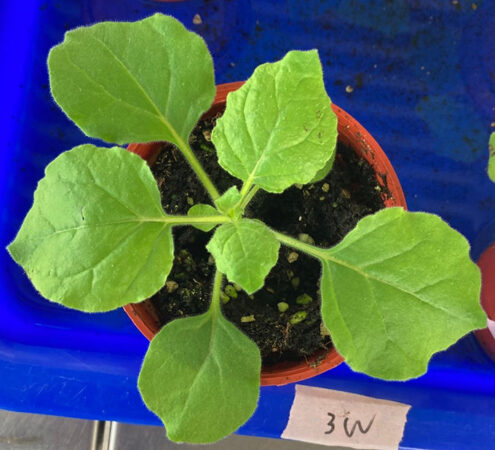
Electric shocks should stress a plant in much the same way that a virus would, the teens reasoned — by activating its immune system. Usually, when a virus attacks, it increases the production of a chemical in the leaves, says Shao-Jyun. Called salicylic (Saa-luh-SILL-ik) acid, this natural compound is responsible for aspirin’s ability to fight inflammation. In tobacco plants, this compound turns on a gene called PR1. It triggers a reaction that alerts the plant to mount a defense against a virus.
“It works to send messages to other leaves,” Fu-Ru explains.
Adds Shao-Jyun, it essentially warns a plant: “Oh, there’s a virus. You should prepare!”
Many types of stress — such as heat and drought — can turn on a plant’s immune system. But a brief electric shock should achieve the same immune benefits, and without harming the plant.
At least, that was the idea.
Shock as vaccine
When each plant was a few weeks old, the teens stuck two copper wires into the stalk beneath a leaf. The wires were connected to a device that sent an electric current to the stalk through one wire and then back through to the device through the other wire. Plants got zapped at different voltages and for different lengths of time. If the voltage was too high or the shock lasted too long, the leaves withered. Fu-Ru and Shao-Jyun got the best results by delivering a 10-volt current for 10 minutes.
Three hours after this shock treatment, the teens froze a plant’s leaves and then extracted genetic information from the plant using PCR. Short for polymerase chain reaction, it’s a technique used to identify genes. These tests showed that the PR1 gene in the treated plants had turned on.
And it proved effective, the young researchers now show.
Fu-Ru and Shao-Jyun scratched the leaves of treated and untreated plants with a gritty sand-like material to create open cuts. Then the teens crushed virus-infected leaves into a juice. Afterward, they rubbed that juice into the wounded, but otherwise healthy, leaves.
They hoped their zapped plants would show less viral infection than untreated plants. Sure enough, the electro-shock treatment cut virus levels by about half. Expression of the PR1 gene in treated plants was much stronger than in untreated plants. This points to the treated plants having a stronger immune defense.

You must be logged in to post a comment.