
Somewhere on a factory floor in Ludhiana or Coimbatore right now, a production line is stalled because a gear motor failed three months before its rated service life. That's not a hypothetical it's the single most common call our sales team fields. Choosing the wrong gear motor doesn't just cost you the unit price. It costs you downtime, missed delivery windows, and a client who won't wait around while you sort out a warranty claim.
Most procurement teams treat a gear motor as a catalog item. It isn't. It's a mechanical decision that determines whether your production line runs at rated capacity or limps along at 70% output for a year before anyone flags it.
The Spec Sheet Detail Most Buyers Skip Past the Torque Rating
Everyone reads the torque figure. Almost nobody reads the duty cycle rating, and that's where most premature failures start.
Motor Types We Manufacture
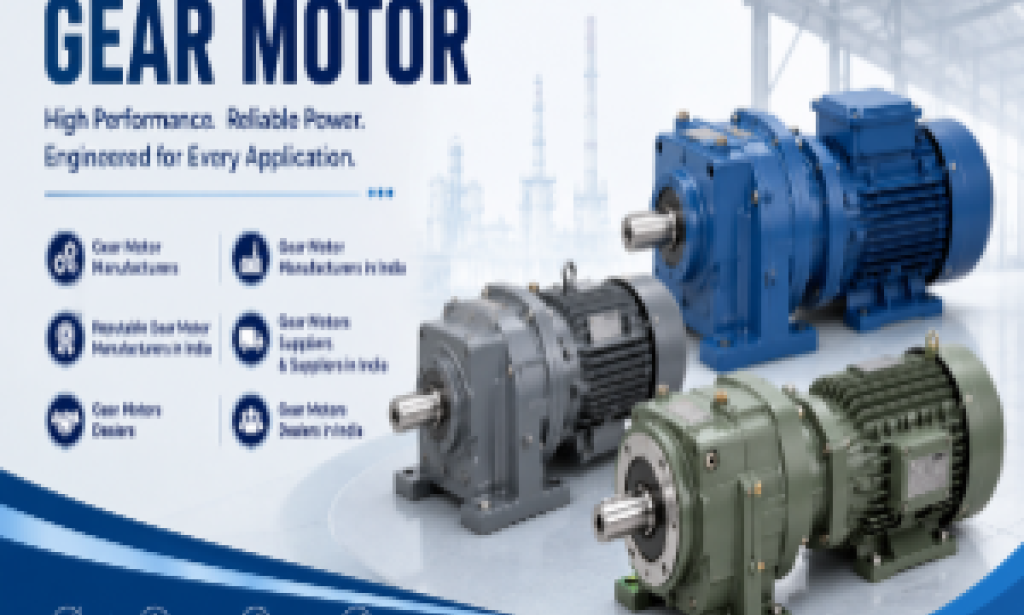
We produce helical, worm, bevel-helical, and planetary gear motors, ranging from fractional horsepower units for packaging lines to heavy-duty motors rated for continuous 24-hour operation on conveyor and mixing applications. Each type suits a different load profile a worm gear motor handles high reduction ratios well but runs hotter under sustained load than a helical unit doing the same job.
Gear Ratios and Torque Range
Our standard range runs from 5:1 to 100:1 reduction, with output torque between 15 Nm and 3,500 Nm depending on frame size. Buyers frequently spec a ratio based on the application's peak load and forget to check the starting torque requirement, which can run 2–3 times higher during motor start-up under a loaded conveyor.
Housing, Duty Cycle, and the Detail That Gets Skipped
Here's the part that gets ignored: duty cycle (S1 through S9) and ambient temperature derating. A motor rated for continuous S1 duty at 40°C ambient will not perform the same way in a poorly ventilated shed in Rajasthan in May, where ambient temperatures cross 45°C by mid-afternoon. Mounting orientation matters too vertical shaft mounting changes lubrication distribution inside a worm gearbox, and not every model is rated for it without a modified oil fill.
Five Questions That Separate a Real Supplier From a Reseller
Before you sign a PO, run any gear motor manufacturerthrough these five checks. We've included what a bad answer sounds like, because vague reassurance is where most bad sourcing decisions actually happen.
-
Is the ISO/CE certification current, and can they produce the certificate on request? Bad answer: "We're certified, don't worry about that." A real supplier hands you the document number and issue date without hesitation.
-
What's the defect and replacement policy in writing? Bad answer: "We'll handle it case by case." That's not a policy that's a negotiation you'll lose after the shipment has already landed and you have no leverage left.
-
Can they confirm lead time with a specific date, not a range? Bad answer: "Somewhere between 3 to 6 weeks, depends." A supplier who can't commit to a week hasn't planned their own production schedule, which means yours is at their mercy.
-
Is raw material sourced and traceable, or bought opportunistically per batch? Bad answer: silence, or a shrug about "quality steel." Batch-to-batch material inconsistency is exactly why two gear motors from the same "model number" sometimes wear at different rates.
-
What does after-sales support actually look like a phone number, or a technician? Bad answer: "Just email us." A supplier without field-level technical support is fine until your motor fails on a Friday and your line sits idle till Monday.
Where a Gear Motor Actually Protects Your Margin
Quality claims are cheap. What matters is whether the motor reduces your risk and protects your margin over its working life, not just on day one.
Lower total cost of ownership comes first a correctly specified gear motor with the right duty cycle rating outlasts a cheaper, undersized unit by years, which means fewer replacement cycles eating into your maintenance budget. Reduced unplanned downtime follows directly from that: a motor running within its rated envelope doesn't overheat and trip out mid-shift. Predictable maintenance intervals matter for anyone running a multi-shift operation, since scheduled servicing is always cheaper than emergency callouts. Energy efficiency shows up on the electricity bill within the first year, particularly on continuous-duty applications where a poorly matched motor draws excess current constantly. Consistent output torque protects product quality on the line itself inconsistent torque delivery is a quiet cause of rejected batches that buyers rarely trace back to the motor. And documented compliance protects you during audits, especially if you're supplying to export clients who ask for traceability paperwork you don't want to be scrambling for at the last minute.
Why Location Is a Supply Chain Decision, Not Just an Address
Buyers searching for gear motor manufacturers in India often treat location as an afterthought. It isn't. Freight time, GST logistics, and access to spare parts all trace back to where your supplier is actually manufacturing, not just where their sales office sits on Google Maps.
We manufacture and ship from our facility with pan-India dispatch, and we work with gear motor suppliers in India across the wholesale, OEM, and industrial procurement channels. For buyers evaluating gear motor dealers in India, proximity to a regional service point cuts replacement part turnaround from weeks down to days on standard models. That single factor has saved more than one of our clients an entire production shift during a mid-run failure. If your current supplier is manufacturing overseas and warehousing locally, ask what happens when the warehouse runs out of your specific gear ratio because it will, eventually.
About Us
We've been manufacturing gear motors since 2013, and we didn't start as a big operation. We started with a small production unit and a handful of clients who needed reliable torque output for textile machinery, and we built out from there. Today we supply wholesalers, OEMs, and brand owners across 22 states.
One thing only a real manufacturer would know: we stopped stocking a particular grade of bronze worm gear in 2022 after two clients in coastal Gujarat reported accelerated wear from humidity exposure during monsoon storage. We switched to a higher-tin bronze alloy for units shipping to coastal regions. That's not a spec sheet change you'll find in a brochure that's ten years of field complaints turning into a production decision.
We're not the cheapest gear motor manufacturer in India, and we won't pretend to be. We compete on the fact that our units are still running when a cheaper import has already been swapped out twice.
Send us your required torque, gear ratio, and duty cycle, and we'll respond with a formal quote within 24 working hours. Our minimum order quantity for standard catalog models is 10 units; custom gear ratios and non-standard mounting configurations start at 25 units. Email your requirement sheet, or call our sales desk directly we'll tell you upfront if a spec you've asked for isn't something we'd recommend for your load profile, rather than just taking the order. That's how Altra Motors has kept repeat clients for over a decade.
Conclusion
A gear motor is not a commodity purchase, whatever your last three suppliers told you. Getting the duty cycle, torque range, and material sourcing right the first time is cheaper than any warranty claim you'll file later. Altra Motors has spent over a decade learning what actually breaks on Indian factory floors, and we build against exactly that. The next production line that doesn't stall over a preventable motor failure could be yours.
FAQs
1. What is the difference between a gear motor and a standard electric motor?
A standard motor delivers high speed and low torque. A gear motor pairs that motor with a gearbox to convert speed into usable torque at a lower RPM which is what most industrial applications, like conveyors and mixers, actually need.
2. How do I choose the right gear motor manufacturer in India?
Check certification currency, ask for a written defect policy, and confirm actual lead times with dates, not ranges. Skip anyone who can't answer these directly without hedging.
3. What is the typical lifespan of an industrial gear motor?
Under correctly matched load and duty cycle, 8 to 12 years is realistic. That range drops sharply sometimes to under 3 years — if the unit is running outside its rated duty cycle, which happens more often than most buyers realize.
4. Do gear motors suppliers in India offer custom gear ratios?
Most reputable gear motor suppliers, including us, offer custom ratios, but expect a longer lead time and a higher minimum order quantity than standard catalog units.
5. What warranty should I expect from gear motor dealers in India?
A minimum of 12 months is standard across most gear motor dealers in India, though terms vary significantly. Read the fine print some dealers exclude wear parts like seals and bearings entirely, which quietly guts the warranty's real value.
6. Can a gear motor be repaired, or does it need full replacement on failure?
Depends on the failure. Bearing or seal failure is usually repairable. Gear tooth wear or shaft damage typically isn't worth repairing the labor cost approaches replacement cost, and we'll tell clients that honestly rather than billing for a repair that won't hold.
7. How does location affect gear motor sourcing in India?
It affects spare parts turnaround and freight cost directly. A supplier manufacturing and dispatching from within India generally gets replacement units to you faster than one relying on imported stock sitting in a regional warehouse.

You must be logged in to post a comment.