

The cycles of heating and cooling are driven by the movement of the moon itself. Every hundred million years or so, the shape of Enceladus’s orbit around Saturn changes, from more circular to more oval and back. When the orbit is more oval, the moon is squeezed tighter by Saturn’s gravity and then released. “It causes the entire ice shelf to be stretched out, almost like it’s being kneaded,” says Rudolph. Just the slight heaving of that ice is enough to heat up the entire moon and melt the shell slightly.
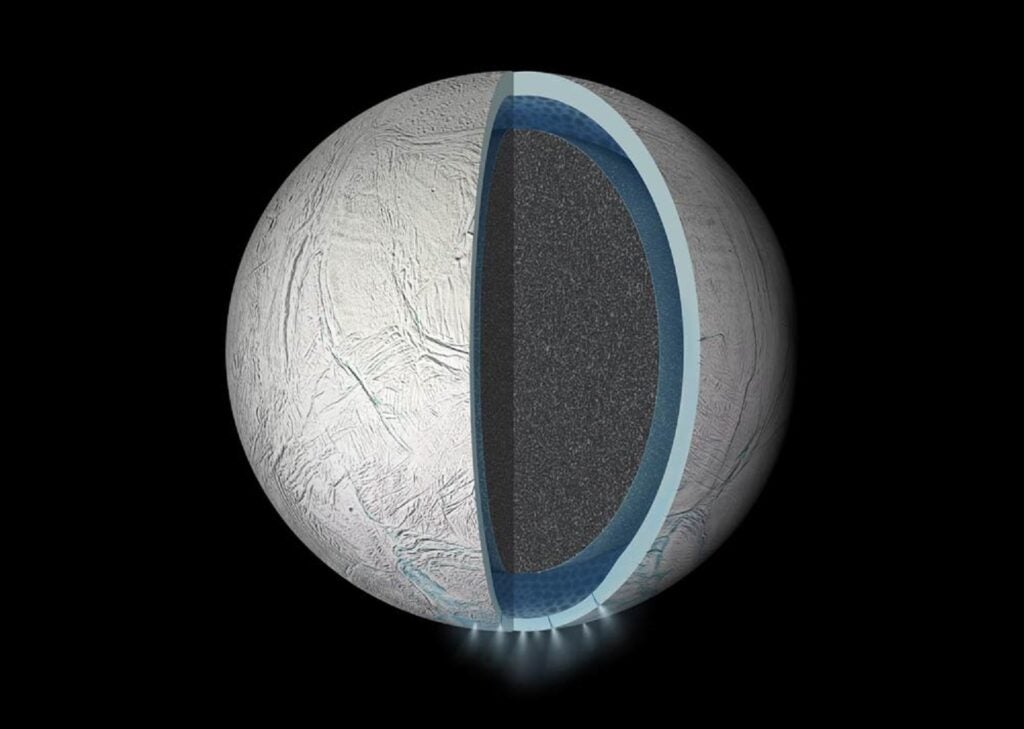
Then, when the moon’s orbit becomes circular, its crust cools down again. The ice shelf expands downward into the hidden ocean. What happens next should be “obvious to anybody who has ever put a bottle of soda into the freezer,” says Rudolph. “The volume change as water freezes to ice causes the pressure to build up. [On Enceladus], this happens on a global scale.”The cracks can only make it down to the ocean at the poles, where the ice is thinnest. “It’s kind of a matter of chance whether the first crack forms at the [Enceladus’s] north pole or the south pole,” says Rudolph. “But once it does, it sets up a series of events that lead to the tiger stripe fissures.” It’s possible that the process has happened repeatedly during each cold cycle.
But the pressure alone doesn’t quite explain the geyser. According to the models run by Rudolph and his team, even all the newly formed ice isn’t enough to squeeze water to the surface. And photos of Enceladus don’t show telltale traces of liquid water spilling out across the moon’s smooth exterior.Here, a process described by Miki Nakajima, an astronomer at Rochester University who was not involved in the new study, might come into play. In 2016, Nakajima demonstrated that if liquid water pushed part of the way up a crack in the ice, it could begin to spontaneously boil in the vacuum of space. “We know the crack thickness on the surface, but we don’t really know what’s going on inside,” Nakajima says. “It could be a straight line; it could be weird.” Vapor could escape anyway because the boiling can happen in even the narrowest of fissures.
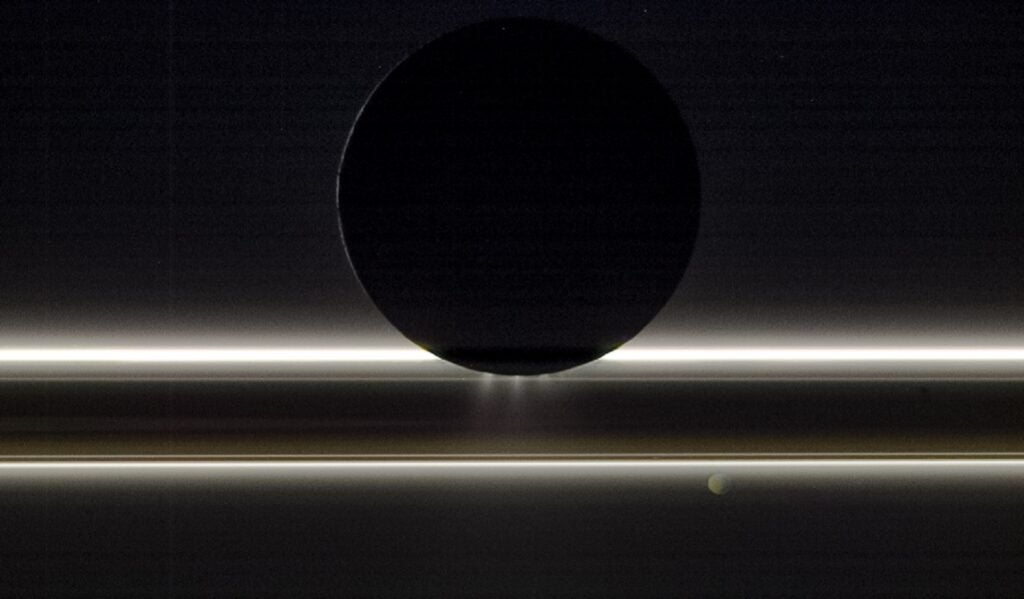
Any one crack leading to the ocean wouldn’t produce much water. Deep in the fissures, the water probably simmers, and a person standing on the surface would be surrounded by a fine mist, not a jet. It would take many crevasses and tubes to produce the geyser humans have photographed from space. Nakajima says that if the explanation is correct, there are many cracks smaller than the tiger stripes on Enceladus that astronomers haven’t gotten close enough to see yet.Saturn’s moon Enceladus drifts before the rings and the tiny moon Pandora in this view that NASA’s Cassini spacecraft captured on November 1, 2009. The entire scene is backlit by the sun, providing striking illumination for the icy particles that make up both the rings and the jets emanating from the south pole of Enceladus. NASA/JPL-Caltech/Space Science Institute
Other forces could be at play, too. Dissolved carbon dioxide or other gases could bubble up to the surface like the carbonation in soda, shooting water to the surface. Unpublished work presented at the American Geophysical Union meeting last year also suggests that water could be released by melting ice in the crevasse, rather than from the buried ocean.Elodie Lesage, an expert on Europa at the NASA Jet Propulsion Laboratory, writes in an email to Popular Science that there’s no direct evidence of cryovolcanoes on Jupiter’s moon, though certain plains of its surface look like they could be the result of liquid water But based on the new findings, she notes, any potential ice volcanoes on Europa probably form for completely different reasons than on Enceladus. “It seems unlikely that liquid water could rise from Europa’s ocean to its surface,” she explains. Instead, pockets of water could be embedded in the crust, and explode out when they begin to freeze, again “like a can of soda someone forgot in a freezer.”
Enceladus was last investigated by the Cassini space probe in 2015—it flew 30 miles above the moon’s surface—while the data on Europa’s ice eruptions mostly comes from far away telescope images. The next mission to Europa is planned to launch in 2024. “Whatever’s going on [there] is less understood,” says Rudolph.

You must be logged in to post a comment.