
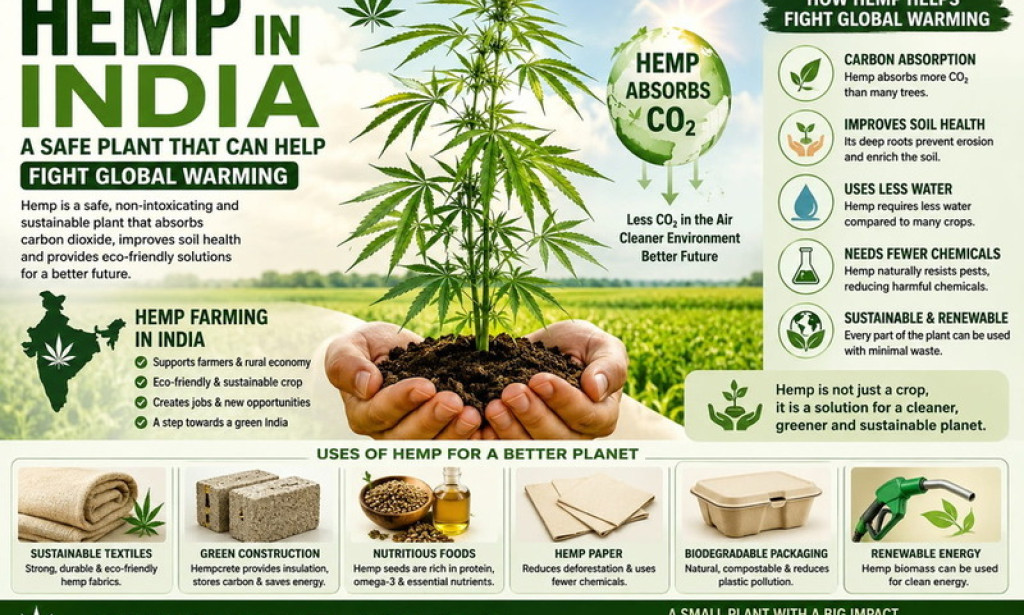
Climate change is one of the greatest challenges facing humanity today. Rising temperatures, unpredictable weather patterns, water scarcity, and increasing carbon emissions are affecting millions of people across the globe. India is also experiencing these challenges through heatwaves, droughts, floods, and declining agricultural productivity.
While governments and industries are investing in renewable energy and sustainable technologies, agriculture can also play a major role in reducing environmental damage. One crop that is attracting worldwide attention for its environmental benefits is industrial hemp.
Industrial hemp is a fast-growing, eco-friendly, and highly versatile plant that can help reduce carbon emissions, improve soil health, conserve natural resources, and create sustainable products. Often called the "Green Crop of the Future," hemp has the potential to become an important part of India's journey toward environmental sustainability.
Understanding Industrial Hemp
Industrial hemp is a variety of the Cannabis sativa plant grown specifically for industrial purposes. It contains only trace amounts of THC, making it non-intoxicating and suitable for commercial cultivation under applicable regulations.
Unlike recreational cannabis, industrial hemp is cultivated for:
- Natural fibers
- Hemp seeds
- Hemp seed oil
- Construction materials
- Paper
- Bioplastics
- Animal bedding
- Organic products
Nearly every part of the hemp plant can be utilized, making it one of the most sustainable agricultural crops available.
Why India Needs Sustainable Crops
India's agricultural sector faces numerous environmental challenges, including:
- Declining groundwater levels
- Soil degradation
- Excessive chemical fertilizer use
- Crop residue burning
- Climate-related crop losses
- Increasing carbon emissions
To overcome these issues, India needs crops that require fewer natural resources while providing better environmental outcomes.
Industrial hemp offers exactly that.
Hemp: Nature's Carbon Capture Plant
One of the biggest advantages of hemp farming is its ability to absorb carbon dioxide from the atmosphere.
During photosynthesis, hemp plants absorb CO₂ and convert it into plant biomass. Some of this captured carbon remains stored in long-lasting hemp products such as building materials, furniture, and fiber products.
Although the amount of carbon stored depends on growing conditions and product lifespans, hemp is widely recognized as a promising crop for supporting carbon-conscious agriculture.
Fast Growth Means Faster Environmental Benefits
Hemp is one of the fastest-growing crops in agriculture.
It can reach maturity within a few months, allowing farmers to produce large amounts of biomass in a relatively short time.
Its rapid growth offers several environmental advantages:
- Quick carbon absorption
- High fiber production
- Efficient land utilization
- Improved agricultural productivity
Hemp Farming Uses Less Water
Water conservation has become one of India's biggest priorities.
Compared to many conventional fiber crops, hemp generally requires less irrigation under suitable growing conditions.
Lower water requirements help:
- Save groundwater
- Reduce irrigation expenses
- Improve drought resilience
- Support sustainable agriculture
Hemp Helps Restore Soil Health
Healthy soil is the foundation of successful farming.
Industrial hemp develops deep root systems that:
- Reduce soil erosion
- Improve soil structure
- Increase organic matter
- Enhance water infiltration
- Support crop rotation systems
Healthier soils can improve long-term farm productivity and resilience.
Reducing Chemical Pollution
Many crops require significant amounts of pesticides and herbicides.
Industrial hemp is naturally resistant to several pests, allowing it to be grown with fewer chemical inputs in many environments.
Reduced chemical use benefits:
- Farmers
- Wildlife
- Pollinators
- Rivers and groundwater
- Overall ecosystem health
Hemp Products That Protect the Environment
Industrial hemp can replace or supplement many environmentally harmful products.
Sustainable Textiles
Hemp fiber produces clothing that is:
- Durable
- Breathable
- Naturally antibacterial
- Biodegradable
- Long-lasting
Choosing hemp fabrics can reduce the environmental impact associated with conventional textile production.
Hemp Paper
Paper made from hemp offers a renewable alternative for certain paper products and can help diversify fiber sources.
Benefits include:
- Reduced dependence on wood pulp
- Strong fibers
- Recyclability
Hemp Bioplastics
Plastic pollution is one of the world's biggest environmental challenges.
Hemp-based bioplastics may help reduce reliance on petroleum-based plastics in some applications.
Potential benefits include:
- Renewable raw materials
- Biodegradability (depending on formulation)
- Lower fossil fuel dependence
Hemp Building Materials
Construction is a major contributor to global carbon emissions.
Hemp-based materials such as hempcrete can improve insulation and contribute to lower operational energy use in buildings.
Advantages include:
- Energy efficiency
- Fire resistance
- Moisture regulation
- Lightweight construction
Hemp Biofuel
Researchers continue to explore hemp biomass as a renewable energy source.
Although not yet widely adopted, hemp-based biofuels could complement other renewable energy technologies.
Supporting Rural India
Industrial hemp farming can create new opportunities for rural communities.
Potential benefits include:
- Additional income sources
- Employment in processing industries
- Local manufacturing
- Value-added agricultural products
- Export opportunities
A growing hemp industry could support farmers while encouraging sustainable economic development.
India's Potential in the Global Hemp Market
The global demand for hemp products continues to increase due to growing interest in sustainable materials.
India has several advantages:
- Diverse climatic conditions
- Agricultural expertise
- Skilled workforce
- Expanding manufacturing sector
- Growing interest in eco-friendly products
With appropriate regulations, infrastructure, and research, India could strengthen its position in the global industrial hemp market.
Challenges That Need Attention
To unlock hemp's full potential, several issues need to be addressed:
- Public misunderstanding about industrial hemp
- State-specific regulatory frameworks
- Limited processing infrastructure
- Need for certified seeds
- Farmer training and technical support
- Investment in research and innovation
Addressing these challenges can help build a responsible and sustainable hemp industry.
A Greener Future with Hemp
Industrial hemp aligns with many sustainable development goals by promoting:
- Climate-friendly agriculture
- Renewable materials
- Water conservation
- Soil restoration
- Reduced pollution
- Circular economy practices
- Rural economic development
While hemp is not a standalone solution to climate change, it can play a meaningful role alongside renewable energy, forest conservation, and sustainable farming practices.

You must be logged in to post a comment.