
Introduction
Fire incidents in Indian industrial facilities carry consequences that extend well beyond immediate physical damage. The National Crime Records Bureau records over 1 lakh fire incidents annually across India, with industrial and factory fires accounting for a disproportionate share of total financial losses. The Confederation of Indian Industry estimates that fire-related losses in Indian manufacturing exceed ₹20,000 crore annually when property damage, production downtime, inventory loss, regulatory penalties, and insurance complications are aggregated.
For manufacturing companies, the consequences of inadequate fire safety system design extend beyond incident response. A poorly designed fire detection, suppression, or evacuation system generates regulatory non-compliance during Factory Act inspections, delays fire NOC approvals from state fire departments, creates penalty exposure under the National Building Code 2016 and state fire prevention acts, and increases insurance premiums for facilities that cannot demonstrate compliant fire risk management.
The decision to hire a fire safety system design consultant is therefore not a routine procurement exercise. It is a risk management decision with direct implications for construction timelines, regulatory approvals, operational continuity, and long-term liability exposure. This article explains what Indian manufacturing companies should evaluate before hiring a fire safety system design consultant, and what separates genuinely competent industrial fire safety consultants from generalist providers without the sector-specific expertise that industrial facilities require.
Why Industrial Fire Safety Design Requires Multi-Regulatory Expertise in 2026
India's industrial fire safety landscape has become significantly more complex in 2026. Manufacturing facilities must now comply with a minimum of 4 to 6 overlapping regulatory frameworks simultaneously, including National Building Code 2016 amendments, TAC (Tariff Advisory Committee) guidelines, PESO regulations, factory licensing requirements under state Factory Acts, and sector-specific norms from CDSCO, FSSAI, or PESO depending on the industry.
India recorded over 9,400 industrial fire incidents in 2023-24, causing losses exceeding Rs. 1,200 crore, with investigation reports attributing more than 60% of cases to design-stage compliance gaps rather than operational failures. This means the risk is built in before the facility even starts production.
Modern industrial facilities face 3 distinct compliance layers: central statutory requirements, state-level fire NOC conditions, and international standards such as NFPA 13, FM Global, or IS 2190 where export customers or insurance underwriters specify them. Meeting all 3 simultaneously requires engineering teams with cross-regulatory knowledge that single-discipline fire consultants typically do not possess.
For greenfield and brownfield projects in pharmaceuticals, chemicals, and food processing, fire safety design errors identified post-construction cost 3 to 8 times more to rectify than upfront multi-regulatory design investment.
IMARC Engineering delivers integrated fire safety and security system design covering all applicable regulatory frameworks from day one.
What Hazardous Area Classification Expertise Reveals About a Consultant
For manufacturing facilities handling flammable liquids, combustible dusts, flammable gases, or explosive atmospheres, hazardous area classification is the foundation of the entire fire and explosion protection design. Hazardous area classification defines which areas of the facility present explosion risk under normal operating conditions, under foreseeable abnormal conditions, or only under rare abnormal conditions, and translates these risk assessments into zone classifications under IS 5572 and IEC 60079 standards.
These zone classifications determine which electrical equipment specifications are permissible in each area, which fire detection technologies are appropriate, which suppression system types are compatible with the hazard profile, and which structural fire protection measures are required. Getting hazardous area classification wrong does not just create a compliance problem. It creates a physical risk that standard fire detection and suppression systems are not designed to address.
Before hiring any fire safety consultant for a facility handling flammable or explosive materials, verify that the consultant has demonstrable hazardous area classification experience under IS 5572, can produce area classification drawings that satisfy Petroleum and Explosives Safety Organisation requirements where applicable, and has designed fire and gas detection systems for facilities with similar hazard profiles. Ask for specific project references in the same industry segment, not general industrial experience.
The Six Technical Capabilities to Evaluate Before Hiring
1. Fire Risk Assessment and Hazard Analysis
A qualified industrial fire safety consultant begins every project with a structured fire risk assessment that quantifies the facility's specific hazard profile rather than applying generic design standards. For chemical and pharmaceutical facilities, this includes process hazard analysis identifying fire and explosion scenarios associated with specific materials and process conditions. Quantified risk assessments for high-hazard facilities calculate fire frequency probabilities and consequence severities that determine the protection system performance requirements. Consultants who move directly to system specification without structured hazard analysis are applying generic solutions to facility-specific risks.
2. Fire Detection System Design for Industrial Environments
Industrial environments present detection challenges that standard smoke detectors and manual call points cannot adequately address. High-bay warehouses with storage heights exceeding 7.5 metres require beam smoke detectors or air sampling detection systems rather than point detectors. Facilities with high-temperature processes, steam, or dust require detection technologies that discriminate between process-generated aerosols and genuine fire signatures. Pharmaceutical cleanrooms require detection systems compatible with the pressure differentials and HVAC configurations that define cleanroom operation. Outdoor storage areas for flammable liquids require flame detectors calibrated to detect hydrocarbon fire signatures.
Evaluate whether the consultant specifies detection systems based on the specific environmental conditions of each area or applies a single detection technology across all facility zones regardless of environmental variation.
3. Suppression System Design and Hydraulic Calculations
Fire suppression system design for industrial facilities involves selection between wet pipe sprinkler systems, dry pipe systems for sub-zero or high-temperature environments, deluge systems for high-hazard areas, foam suppression systems for flammable liquid storage, gaseous suppression systems for enclosed electrical or electronic equipment rooms, and water mist systems for specific suppression applications. Each system type has defined application criteria, performance standards under IS 15105, NFPA 13, and FM Global standards, and hydraulic design requirements that must be verified through engineering calculations.
Hydraulic calculations for sprinkler and deluge systems determine pipe sizing, pump capacity, and water storage requirements that directly affect civil and structural design. Errors in hydraulic calculations produce systems that cannot deliver the required suppression performance at the design fire scenario, which only becomes apparent during acceptance testing or, more seriously, during an actual fire event.
4. Fire Water Storage and Pump System Engineering
The National Building Code 2016 and TAC guidelines specify minimum fire water storage requirements based on facility occupancy classification, building area, and hazard category. For high-hazard industrial facilities, fire water storage requirements frequently exceed 500,000 litres, and fire pump system design must provide the pressure and flow rates required by the suppression system hydraulic calculations simultaneously across multiple operating zones.
Fire pump selection, standby pump configuration, diesel backup pump specification, pump house layout, and fire water ring main design are engineering disciplines requiring specific competence. A consultant who subcontracts hydraulic engineering and pump system design without integrating it into the overall fire protection system design produces disconnected specifications that create coordination problems during construction and commissioning.
5. Emergency Evacuation and Passive Fire Protection
Active fire detection and suppression systems perform within defined response times. Passive fire protection, covering fire-rated wall and floor construction, fire doors, fire dampers in HVAC penetrations, intumescent sealing of cable and pipe penetrations, and structural fire protection for steel elements, provides the time delay that allows safe evacuation and limits fire spread between compartments during the period before suppression systems achieve control.
Evacuation route design for industrial facilities must account for the specific movement constraints of production environments, including personal protective equipment requirements that limit mobility, high-noise environments where audible alarms may be insufficient, and facilities with large numbers of workers across multiple floor levels. A fire safety consultant who designs active systems without integrating passive fire protection and evacuation system design is delivering an incomplete fire protection solution.
6. Regulatory Submission and Fire NOC Support
The practical value of a fire safety consultant extends to their ability to prepare and support the regulatory submissions required to obtain construction approvals and fire NOC from state fire departments. Fire NOC applications require detailed fire protection system drawings, fire safety report documentation, and technical responses to observations raised by fire department reviewers. Consultants with established relationships and submission experience with state fire departments in the relevant jurisdiction consistently achieve faster NOC approvals with fewer revision cycles than consultants without local regulatory experience.
For pharmaceutical facilities seeking CDSCO approval, food processing facilities seeking FSSAI licensing, and any facility requiring environmental clearance, the fire safety system documentation forms part of a larger regulatory submission package. Consultants who understand how fire safety documentation integrates with broader regulatory workflows reduce overall approval timeline risk.
Questions to Ask Before Signing a Fire Safety Consulting Contract
Before engaging any fire safety system design consultant for an industrial facility in India, the following questions establish the minimum competence threshold:
- How many industrial facilities in the same sector have you completed fire protection designs for in the last five years, and can you provide references from those clients?
- Have you completed hazardous area classification under IS 5572 for facilities with similar hazard profiles?
- Do your designs include full hydraulic calculations for suppression systems, or are hydraulic calculations subcontracted?
- Which state fire departments have you submitted fire NOC applications to, and what is your typical revision cycle experience?
- Does your scope include passive fire protection specification and evacuation system design, or only active detection and suppression systems?
- How do you coordinate fire safety system design with structural, MEP, and process design disciplines on the same project?
A consultant who cannot provide clear, specific answers to these questions with reference to actual project experience is not adequately qualified for industrial facility fire safety design, regardless of their general engineering credentials.
How IMARC Engineering Supports Industrial Fire Safety System Design
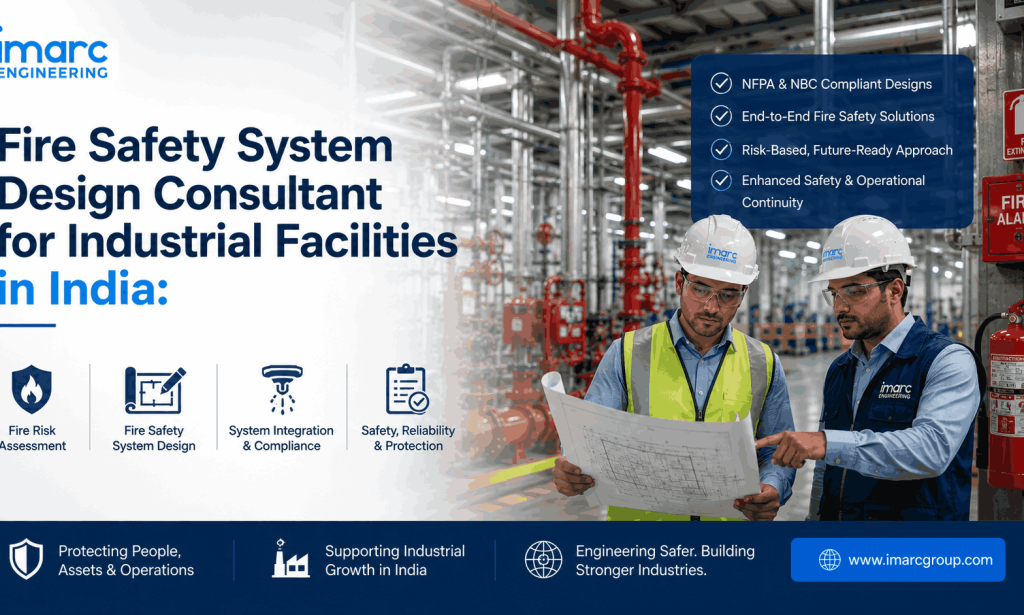
IMARC Engineering provides fire safety and security system design consulting services for manufacturing and industrial facility projects across India. Our scope covers fire risk assessment and hazard analysis, hazardous area classification, fire detection system design, suppression system design with full hydraulic calculations, fire water storage and pump system engineering, passive fire protection specification, emergency evacuation system design, security system integration, and fire NOC application support.
Our fire safety designs are developed in coordination with structural, civil, MEP, and process design disciplines, ensuring that fire protection system requirements are integrated into the facility design from the earliest project stages rather than retrofitted after other disciplines have established their layouts.
Consult to the Our Team: https://www.imarcengineering.com/contact?service=fire-safety-and-security-system-design
Conclusion
Hiring a fire safety system design consultant for an industrial facility in India is a decision that affects construction cost, regulatory approval timelines, insurance liability, and physical safety outcomes throughout the facility's operating life. The right consultant brings sector-specific hazard analysis capability, multi-regulatory compliance knowledge, integrated active and passive fire protection design, and practical regulatory submission experience. The wrong consultant produces designs that generate NOC rejections, construction rework, and compliance gaps that surface during inspections or incident investigations.
For Indian manufacturing companies investing in new greenfield facilities, brownfield expansions, or facility modifications, the evaluation criteria outlined in this article provide a practical framework for identifying fire safety consultants with the genuine industrial expertise that complex manufacturing facilities require.

You must be logged in to post a comment.