
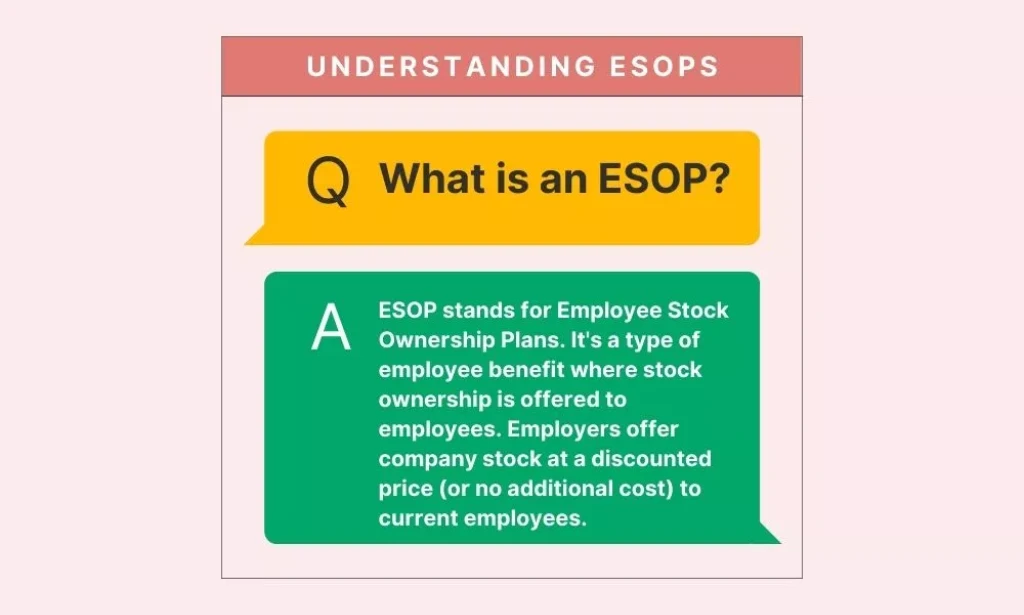
The esop full form is Employee Stock Ownership Plan. An ESOP is a company-sponsored benefit programme that gives employees the right to own shares in the company they work for, either at no cost, at a discounted price, or at a predetermined exercise price.
ESOPs are widely used as a retention and motivation tool by companies ranging from large listed corporations to pre-IPO startups. In India, they are governed by the SEBI (Share Based Employee Benefits and Sweat Equity) Regulations, 2021, which laid down clear guidelines on grant, vesting, and exercise of options.
Key Terms You Should Know Under an ESOP Policy
An esop policy typically contains several important terms that every employee should understand before signing or accepting a grant.
Grant Date is the date on which the company formally offers the options to the employee. Exercise Price (also called Strike Price) is the price at which the employee can buy the shares, fixed on the grant date. Vesting Period is the time the employee must remain with the company before the options can be exercised — commonly between one and four years. Cliff is the minimum period before any options vest at all. Exercise Window is the period after vesting during which the employee can choose to convert options into shares.
Understanding these terms directly affects how and when you realise the financial value of your ESOP grant.
What ESOPs Mean for Career Growth
ESOPs do more than provide a financial incentive—they change the employee's relationship with the company. When you hold options or shares, you are no longer just an employee; you are a stakeholder. This often leads to greater motivation, longer tenure, and a stronger sense of contribution to the company's success.
For professionals in growth-stage companies, ESOPs can represent a significant portion of total compensation. Many employees at Indian unicorns and new-age companies have benefited substantially from ESOPs when their companies went public or were acquired. Understanding the esop full form, which stands for Employee Stock Ownership Plan, also helps employees better appreciate how these equity-based benefits work and contribute to long-term wealth creation.
Common Misconceptions About ESOPs
One common misconception is that ESOP options are equivalent to cash. They are not—they are rights, not guarantees. The value depends entirely on the company's performance and the outcome of any liquidity event like an IPO or acquisition. Until then, unlisted ESOPs may have limited liquidity.
Another misconception is that employees must exercise all their options at once. Most ESOP policies allow partial exercise, giving employees flexibility in timing their tax liability and cash outflow.
How to Make the Most of Your ESOP Grant
The key is to stay informed. Read your esop policy document thoroughly, note your vesting schedule, understand the tax treatment at each stage, and plan your finances accordingly. Consulting a financial planner or CA who specialises in equity compensation can help you optimise your decisions around exercise timing and post-exercise holding strategy.
For professionals who have vested but not yet exercised, the question is often about cash flow — you need funds to pay the exercise price and the resulting tax liability. Some lenders offer financing specifically for ESOP exercise, which can be a practical solution.

You must be logged in to post a comment.