

Abstract:
A consensus among scholars on the importance of international trade and foreign direct investment as a main macroeconomic variables that drive economic growth of developing countries. However, the global economic crisis plays dominant role in determining the movement of these macroeconomic variables that can change the nomenclature of economic activities in relation with trade and FDI inflow. For this purpose, this study investigates the relationship between trade openness, FDI inflow and economic growth of Nigeria by accounting for the effects of global economic crisis of 2007–2008 and commodity crisis of 2016 using Bayer (in J Time Anal 34(1):83–95, 2013) approach to augmented autoregressive distributed lag method on time series data from 1982 to 2018. The results provide evidence that (1) global economic crisis significantly dampens economic growth. (2) The negative interaction of total trade, FDI and global financial economic crisis is substantive enough to dampen the trade-growth and FDI-growth led relationship. (3) The negative interaction of FDI-inflow with global economic crisis is more pronounced and substantive in the long run than the short run. This study recommends for policy option positioned towards escalating specific fiscal measure that should provide sound legislative rules and reductions in taxes for international investors; stimulus measures targeting measures to control public spending, which had previously fuelled economic expansion.
Introduction :
In the wake of mid-2007 to Q1 2009, the world was taken by storm, when the sub-prime mortgage market in the United States plunged to an all-time low; indeed, the United States housing market bubble burst alongside excessive risk exposure of financial institutions catalyzed a severe global economic and financial crisis spreading from the United States to the rest of the world through the auspices of interlinkages in the global financial system.
Based on the above explanation, issues surrounding how economic crisis affects trade-led growth and foreign direct investment (FDI)-led growth have continued to dominate the research arena. The result of their research findings is still mixed and inconclusive. While some extant studies established that economic crisis generates a negative effect on trade and FDI inflow in driving economic growth [1, 6, 17, 19, 34], some other scholars document that economic crisis has a significant direct effect on trade and FDI inflow in driving economic growth [18, 53, 64] (7th Islamic month 2018). In the case of Nigeria, international trade is one of the channels pencilled to have paved the way for an economic crisis in the Nigerian economy. Figure 1 shows the increase in decomposed total trade (exports and imports % Gross domestic product (GDP)) and FDI inflow % GDP in recent years. The trend of these variables do not follow a definite pattern, see (Fig. 1); it fluctuates upwards and downwards at its lowest point during the 2007–2008 global financial crisis and commodity price shock in 2016. This fluctuation of macroeconomic variables engineered by the global economic crisis may dampen the trade-led growth or FDI-led growth and subsequently escalate a negative effect that drains the positive effect of trade openness and FDI inflow on growth.
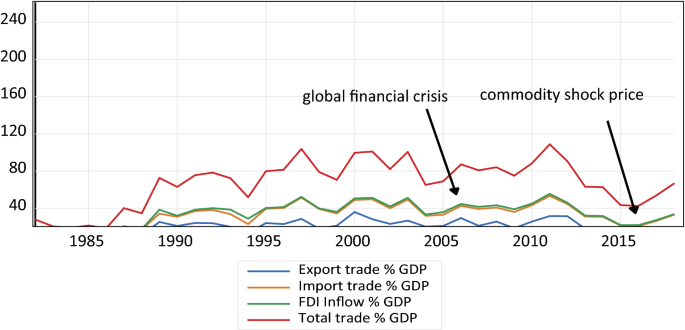
Time evolution of export trade % GDP, import trade % GDP, FDI inflow % GDP, total trade % GDP indicating the global economic crisis (2007, 2008) and commodity shock price 2016. Sources: author’s design.
Review of related Literature:
Theoretical Literature:
There is a battery of advantages attached to FDI inflows in engendering growth in host economies and well-advertised in available academic literature (see [5, 33, 78]). Theoretical standpoint as seen in Organization for Economic Co-operation and Development (OECD) (2002) report reinforced in the study of Forte (2010) mentioned the several channels through which FDI engenders growth, namely; (a) transfer of new technologies and technical know-how (b) human resources (c) integration into the global economy (d) increased competition in host markets (e) economic and political interference. The channels mentioned above are either transmitting positive effects or negative effects, reinforcing the failure of authors in the last decade due to their one-direction skewed attitude, contributing to the lack of consensus on the FDI-growth debate. Some schools of thought opine that for growth to occur, human capital capable of absorbing technological and knowledge transfers must be radially in line.

You must be logged in to post a comment.