

- NEWS FEATURE
- 25 May 2022
COVID derailed learning for 1.6 billion students. Here’s how schools can help them catch up
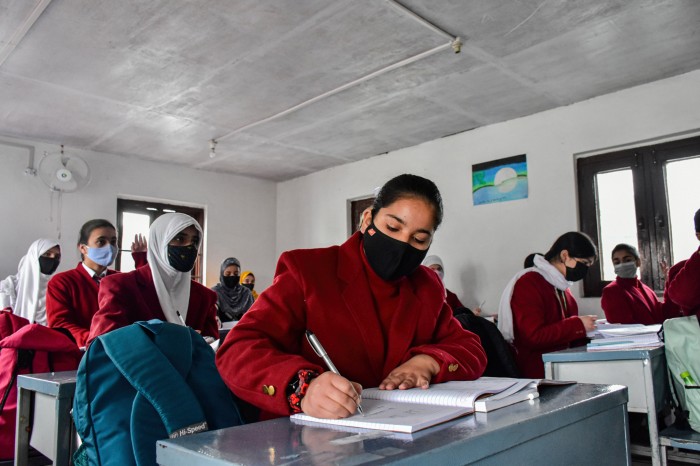
Students in India in March; schools there were closed for months earlier in the pandemic. Credit: Saqib Majeed/SOPA Images/LightRocket/Getty
By October last year, Meg Brydon could see the terrible toll the pandemic had taken on children at her school. Brydon was a teacher at Ashwood High School, in the suburbs of Melbourne, Australia — the city that has spent more time in COVID-19 lockdowns than any other in the world. The school had been closed, on and off, for about seven months.
Before the pandemic, around 10% of children who joined Ashwood at the age of 12 would be below the expected national standard. But in the latest cohort, Brydon could see that a shocking 30% of them were behind. And the damage ran even deeper. So many children had behavioural or psychological problems after lockdowns that some were getting violent, and the school hired a full-time psychologist to help. “The number of referrals to her was astronomical,” Brydon says.
Similar scenarios have played out in classrooms around the world. By February this year, schools globally had been closed because of COVID-19 for an average of 4.5 months, affecting an estimated 1.6 billion students and creating what the United Nations has called the largest disruption to education in history. Even 2 years into the pandemic, 48 countries had not yet fully reopened their schools, according to the UN cultural organization UNESCO.
The consequences of these closures follow a sad but predictable course. In rich countries, disadvantaged and vulnerable children have fallen behind the most. Those in poorer countries have been the hardest hit, and millions will never go back to school at all. UNESCO estimates that today’s generation of students could lose US$17 trillion in lifetime earnings at current values because of missed learning and skills. “We’re really talking about a generational loss,” says Margarete Sachs-Israel, who leads the Inclusive Quality Education Section at UNESCO in Bangkok.
Now, governments and schools need to know the best approach to help children catch up — and research could show the way. Over the past 20–30 years, researchers in education, economics and international development have built substantial bodies of evidence, including banks of randomized controlled trials, showing strategies that are effective at boosting school attendance and learning. They reveal, for example, that tutoring is one of the most cost-effective ways to help children to make up lost ground. And some countries are drawing on this evidence in their COVID-19 responses, putting a focus on tutoring and other programmes that educational studies have shown to be effective.In late 2010, evidence-informed education got one of its biggest boosts when the UK government invested £125 million (US$156 million) to raise standards in schools. This gave rise to the Education Endowment Foundation (EEF), a non-profit organization in London that has since become a leader in educational research. It has funded at least 160 randomized controlled trials in education, probably more than any other organization in the world. Around half of English schools have taken part in these trials. The investment in the EEF “had a ripple effect around the world”, says Annette Boaz, who studies evidence and policy at the London School of Hygiene & Tropical Medicine.

You must be logged in to post a comment.