

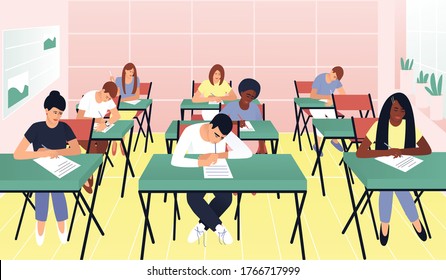
By October last year, Meg Brydon could see the terrible toll the pandemic had taken on children at her school. Brydon was a teacher at Ashwood High School, in the suburbs of Melbourne, Australia — the city that has spent more time in COVID-19 lockdowns than any other in the world. The school had been closed, on and off, for about seven months.
Before the pandemic, around 10% of children who joined Ashwood at the age of 12 would be below the expected national standard. But in the latest cohort, Brydon could see that a shocking 30% of them were behind. And the damage ran even deeper. So many children had behavioural or psychological problems after lockdowns that some were getting violent, and the school hired a full-time psychologist to help. “The number of referrals to her was astronomical,” Brydon says.
Similar scenarios have played out in classrooms around the world. By February this year, schools globally had been closed because of COVID-19 for an average of 4.5 months, affecting an estimated 1.6 billion students and creating what the United Nations has called the largest disruption to education in history. Even 2 years into the pandemic, 48 countries had not yet fully reopened their schools, according to the UN cultural organization UNESCO.
The consequences of these closures follow a sad but predictable course. In rich countries, disadvantaged and vulnerable children have fallen behind the most. Those in poorer countries have been the hardest hit, and millions will never go back to school at all. UNESCO estimates that today’s generation of students could lose US$17 trillion in lifetime earnings at current values because of missed learning and skills. “We’re really talking about a generational loss,” says Margarete Sachs-Israel, who leads the Inclusive Quality Education Section at UNESCO in Bangkok.
Now, governments and schools need to know the best approach to help children catch up — and research could show the way. Over the past 20–30 years, researchers in education, economics and international development have built substantial bodies of evidence, including banks of randomized controlled trials, showing strategies that are effective at boosting school attendance and learning. They reveal, for example, that tutoring is one of the most cost-effective ways to help children to make up lost ground. And some countries are drawing on this evidence in their COVID-19 responses, putting a focus on tutoring and other programmes that educational studies have shown to be effective.
But experts point to a number of concerns. The true extent of learning losses in the pandemic is not yet clear; educational research rarely provides simple answers about what to do; and nations might not use this opportunity to make much-needed systemic change. “Every single time there’s been a calamity in the world, we’ve rushed back to the old normal fast,” says John Hattie, an educational researcher at the University of Melbourne. “The biggest travesty of COVID is if we learn nothing.”
What’s more, the scale of the task ahead is immense. Researchers and education experts are concerned that the amounts being invested are laughably insufficient, given the number of students who need help. “It’s a real test for the global community,” says Kenneth Russell, an education specialist at the UN children’s charity UNICEF in New York. “And I don’t think the magnitude of the response matches the magnitude of the need.”
Even so, the pandemic could eventually drive some transformative changes in education — ones that both improve practices and reach more students, researchers say. “I do think it has thrown into the air many of the assumptions that we make about education,” says Lee Elliot Major, who studies social mobility at the University of Exeter, UK.
Tough sell
The concept of using research in education has been a long, tough sell. “The fundamental issue is that many practitioners do not believe it will ever be a science,” says Andreas Schleicher, who heads the directorate for education and skills at the Organisation for Economic Co-operation and Development (OECD) in Paris. Teachers are not expected to browse academic journals, and educational policies are often set by the ideology of bureaucrats rather than by research showing what actually works. “Many of them use evidence to confirm what they want to do,” Schleicher says.
Some researchers and educators have been trying to change that view for decades. They want education to operate more like medicine, where a drug typically has to be proven effective in randomized controlled trials before it’s used. Advocates of evidence-informed education argue that teaching and learning methods should also be shown to work by research — rather than being used because of tradition, opinion or the latest fad. But they acknowledge that testing whether a method improves educational outcomes is often more complex than testing whether a drug improves health.

You must be logged in to post a comment.