
Introduction
The SEO industry is entering a new era where artificial intelligence and automation are reshaping how websites rank on Google. Businesses are rapidly publishing AI-generated content at scale, while advanced marketers are investing heavily in Programmatic SEO frameworks to dominate search visibility.
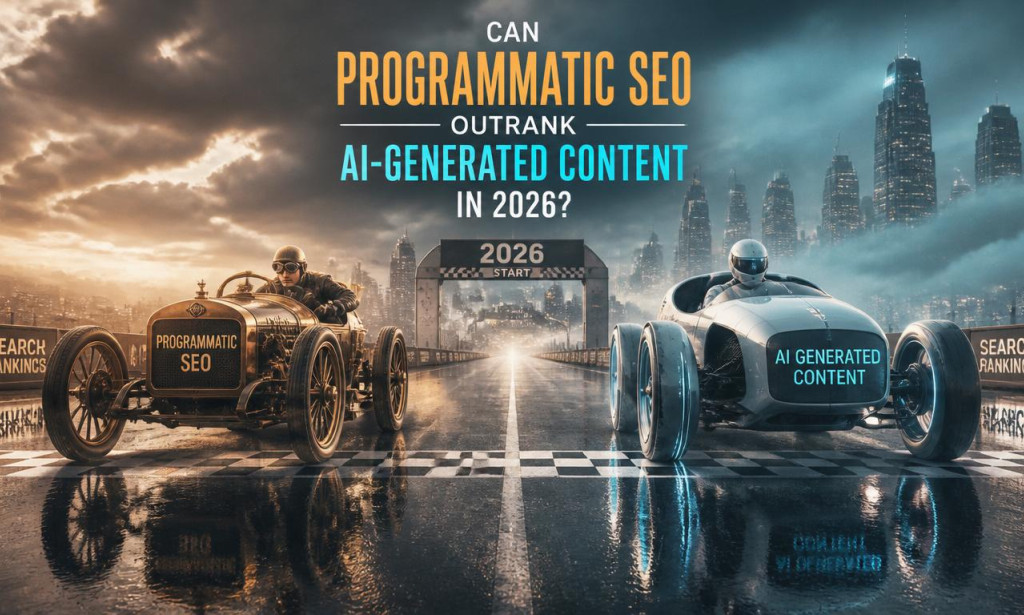
This raises a critical question for digital marketers in 2026: Can Programmatic SEO outperform AI-generated content in Google Search rankings?
The answer depends on content quality, user intent optimization, semantic relevance, and technical SEO implementation. As Google becomes increasingly sophisticated through AI-powered ranking systems and Search Generative Experience (SGE), websites must deliver more than keyword stuffing and mass-produced articles.
This article explores how Programmatic SEO compares to AI-generated content and which strategy offers the strongest long-term SEO advantage.
What Is Programmatic SEO? A Scalable Strategy for Modern Search Visibility
Programmatic SEO is a scalable SEO strategy that uses automation, structured databases, and dynamic page generation to create thousands of optimized landing pages targeting specific search queries.
Instead of manually writing every page, marketers develop templates powered by:
- Keyword datasets
- Search intent mapping
- Internal linking systems
- Structured schema markup
- Dynamic content variables
Leading companies like Zapier and Canva have successfully used Programmatic SEO to generate massive organic traffic growth.
The primary advantage is scalability while maintaining strong search intent relevance.
Why AI-Generated Content Is Dominating Search
AI-generated content has transformed digital publishing. Tools developed by OpenAI and Google allow businesses to produce articles in minutes rather than hours.
According to industry studies:
- Over 80% of marketers now use AI for content creation.
- AI workflows reduce production costs significantly.
- Automated content publishing improves publishing frequency.
However, Google’s Helpful Content System increasingly prioritizes:
- Experience-based content
- Original insights
- Content usefulness
- Expertise and trust signals
- User engagement metrics
This means low-quality AI content without strategic optimization often struggles to maintain rankings.
Programmatic SEO vs AI Content: Key Differences
1. Search Intent Optimization
Programmatic SEO is highly effective at targeting long-tail keywords and matching specific user intent.
Examples include:
- “Best CRM for law firms”
- “Technical SEO checklist for ecommerce sites”
- “SEO tools for SaaS startups”
Because these pages are designed around search behavior data, they often satisfy user queries more effectively than generic AI-written articles.
Advantage:
Programmatic SEO
2. Scalability
AI-generated content scales extremely fast. Businesses can create hundreds of articles daily using automation tools.
Programmatic SEO also scales efficiently, but requires:
- Database management
- Page templating
- Technical SEO infrastructure
- Dynamic internal linking
Advantage:
AI-Generated Content
3. Topical Authority
Google rewards websites demonstrating deep topical expertise across entire content ecosystems.
Programmatic SEO strengthens topical authority through:
- Semantic keyword clustering
- Content silos
- Entity optimization
- Structured data markup
This creates stronger contextual relevance in Google’s algorithms.
Advantage:
Programmatic SEO
4. Content Quality amp; E-E-A-T
Many AI-generated pages suffer from:
- Repetitive phrasing
- Lack of originality
- Thin content quality
- Weak expertise signals
Google’s E-E-A-T principles (Experience, Expertise, Authoritativeness, and Trustworthiness) increasingly impact rankings.
Programmatic SEO pages enhanced with human editing, proprietary insights, and expert analysis tend to perform better long term.
Advantage:
Programmatic SEO
Why Google May Favor Programmatic SEO in 2026
Google’s ranking systems are evolving toward:
- Semantic understanding
- User satisfaction metrics
- Helpful content evaluation
- AI-powered query interpretation
- Entity-based indexing
Programmatic SEO naturally aligns with these ranking factors because it focuses on highly targeted pages designed around precise search intent.
In contrast, mass AI-generated content often lacks the structured topical depth Google prefers.
Additionally, Google AI Overviews prioritize:
- Concise answers
- Structured formatting
- Contextual relevance
- Authoritative information
Programmatic SEO frameworks are highly compatible with these requirements.
The Future: Hybrid SEO Strategies
The future of SEO is not purely human content or AI automation.
The most effective strategy combines:
- Programmatic SEO systems
- AI-assisted workflows
- Human editorial oversight
- Semantic SEO optimization
- Technical SEO enhancements
Modern marketers increasingly use AI for:
- Keyword clustering
- Content briefs
- SERP analysis
- Schema generation
- Topic research
Then combine those insights with Programmatic SEO to scale high-quality search experiences.
This hybrid approach delivers both efficiency and ranking stability.
Recommended Internal Linking Strategy
To strengthen SEO performance, internally link this article to:
- Technical SEO guides
- Semantic SEO tutorials
- AI content optimization resources
- Search intent analysis articles
- Topical authority case studies
This improves crawlability, user engagement, and topical relevance.
Recommended External Sources
Reference authoritative industry resources such as:
These sources improve credibility and trustworthiness.
Multimedia Recommendations
Enhance engagement using:
Images
- Programmatic SEO workflow diagrams
- AI content vs Programmatic SEO comparison charts
- Google ranking factor visuals
Infographics
- “Future of SEO in 2026”
- “How Programmatic SEO Works”
- “AI Content Optimization Process”
Videos
Embed tutorials covering:
- Technical SEO implementation
- AI-assisted content creation
- Google algorithm update analysis
Conclusion
Programmatic SEO remains one of the most powerful organic growth strategies in 2026. While AI-generated content offers incredible speed and scalability, it often lacks the topical authority, semantic depth, and search intent precision required for sustainable rankings.
The businesses that will dominate future search results are those combining Programmatic SEO, AI automation, semantic optimization, and human expertise into one integrated SEO strategy.
Call To Action
Want to future-proof your organic traffic strategy? Start building scalable Programmatic SEO systems enhanced with AI-assisted optimization and expert-driven content frameworks to improve rankings, authority, and long-term search visibility.

You must be logged in to post a comment.