

AIRFOIL
DEFINITION :
A structure with curved surfaces designed to give the most favourable ratio of lift to drag in flight, used as the basic form of the wings, fins, and tailplanes of most aircraft. North American term airfoil
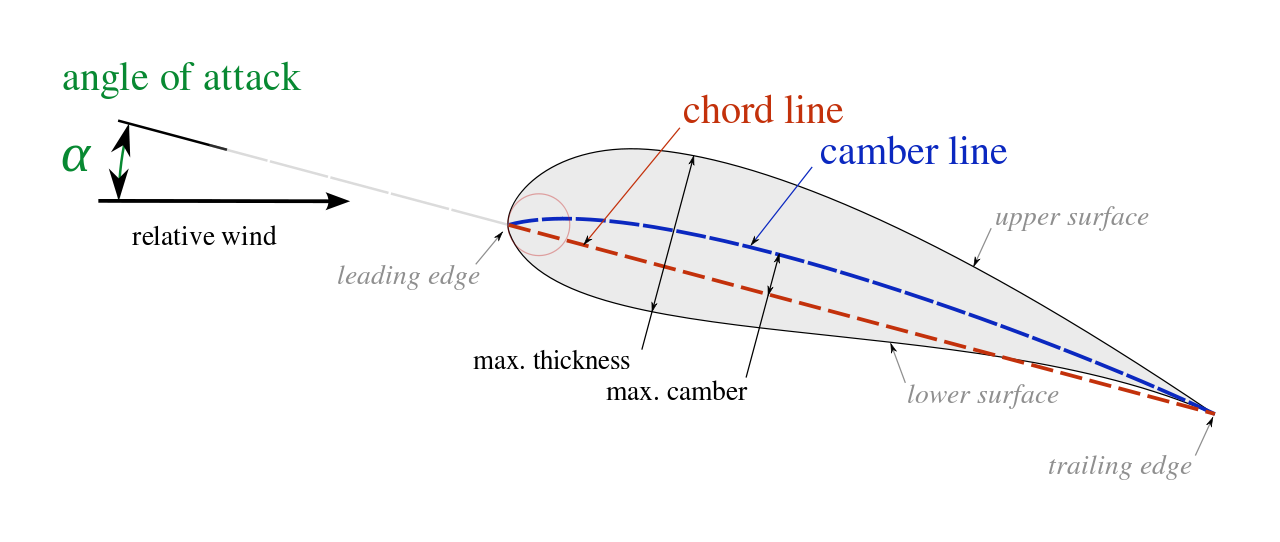
TERMINOLOGY :
CHORD :The chord of a wing is the width of the wing from the leading edge apex to the trailing
CHORD LINE: A chord line is a line depicting the chord which extends forward of the leading edge
AVERAGE CHORD : The average chord is the area of the wing divided by the wing span.
THE MEAN AERODYNAMIC CHORD : The mean aerodynamic chord is the average distance from the leading edge to the trailing edge of the wing
ANGLE OF INCIDENCE :The acute angle the wing chord makes with the longitudinal axis of the aircraft is called the angle of incidence, or the angle of wing setting.
The angle of incidence in most cases is a fixed, built-in angle. When the leading edge of the wing is higher than the trailing edge, the angle of incidence is said to be positive. The angle of incidence is negative when the leading edge is lower than the trailing edge of the wing.
LEADING EDGE :the foremost edge of an airfoil, where air touches first .
TRAILING EDGE :trailing edge The aft edge of an airfoil or a wing. Air passes last over this portion of the airfoil
ANGLE OF ATTACK :The angle of attack (AOA) is the angle at which the chord of an aircraft’s wing meets the relative wind. The chord is a straight line from the leading edge to the trailing edge.
SHAPES OF THE AIRFOIL :

The shape of the airfoil determines the amount of turbulence or skin friction that it produces, consequently affecting the efficiency of the wing. Turbulence and skin friction are controlled mainly by the fineness ratio, which is defined as the ratio of the chord of the airfoil to its maximum thickness. If the wing has a high fineness ratio, it is a very thin wing. A thick wing has a low fineness ratio. A wing with a high fineness ratio produces a large amount of skin friction. A wing with a low fineness ratio produces a large amount of turbulence. The best wing is a compromise between these two extremes to hold both turbulence and skin friction to a minimum
High-lift wings and high-lift devices for wings have been developed by shaping the airfoils to produce the desired effect. The amount of lift produced by an airfoil increases with an increase in wing camber. As stated, camber refers to the curvature of an airfoil surface above and below the chord line. Upper camber refers to the upper surface, lower camber to the lower surface, and mean camber to the mean line of the section. Camber is positive when departure from the chord line is outward and negative when it is inward. Thus, high-lift wings have a large positive camber on the upper surface and a slightly negative camber on the lower surface.
Wing flaps cause an ordinary wing to approximate this same condition by increasing the upper camber and by creating a negative lower camber. It is also known that the larger the wingspan, as compared to the chord, the greater the lift obtained. This comparison is called aspect ratio. The higher the aspect ratio, the greater the lift. In spite of the benefits from an increase in aspect ratio, there are definite limitations defined by structural and drag considerations. On the other hand, an airfoil that is perfectly streamlined and offers little wind resistance sometimes does not have enough lifting power to take the aircraft off the ground. Thus, modern aircraft have airfoils which strike a medium between extremes, the shape depending on the purposes of the aircraft for which it is designed

You must be logged in to post a comment.