
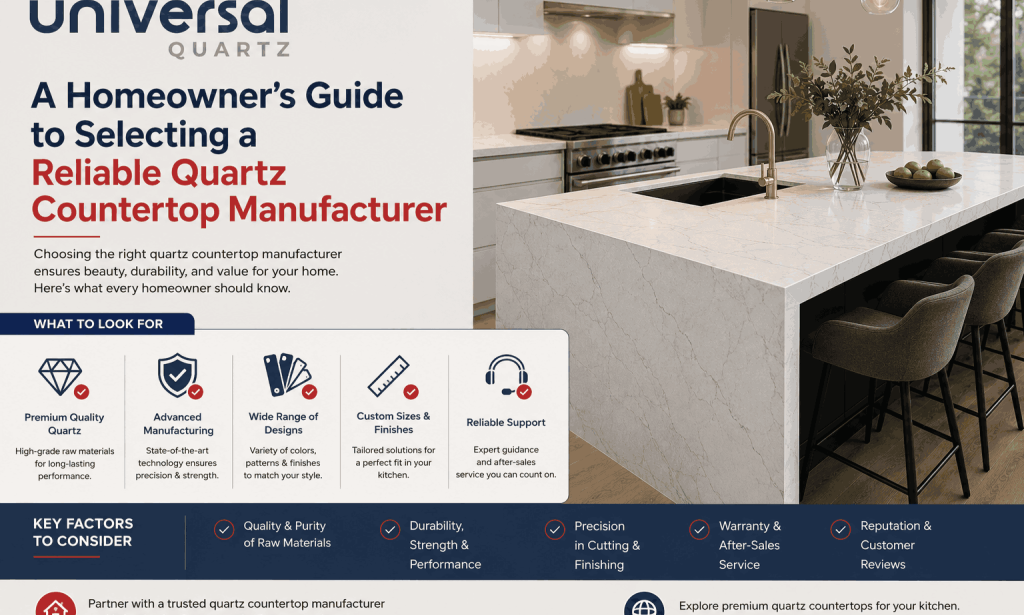
If you've started shopping for kitchen countertops, you've probably noticed how quickly the options start to blur together. Every showroom has rows of quartz slabs in similar whites, greys, and veined patterns, and every salesperson will tell you their product is "premium." As a homeowner, how are you supposed to tell the difference?
The honest answer: the slab itself often can't tell you much on its own. What actually separates a countertop that holds up for decades from one that disappoints within a few years is the manufacturer standing behind it. Here's how to evaluate one properly.
Start With How the Slab Is Made, Not How It Looks
It's tempting to make a decision based purely on color and pattern, but the manufacturing process is what determines whether that beautiful slab will still look beautiful in ten years. Quality manufacturers use vacuum compression and high-pressure molding to bind quartz particles and resin tightly together, producing a dense, non-porous surface. Lower-quality production can leave tiny air pockets or inconsistencies that weaken the slab over time, even if it looks flawless on day one.
As a homeowner, you're not expected to become a materials engineer — but it's fair to ask your supplier directly what process they use and why it matters.
Check for Real Certifications, Not Just Marketing Claims
Any manufacturer can claim their quartz is "top quality." Certifications are one of the few objective ways to verify that. Look for recognized quality and environmental standards — ISO certification, green building compliance, and similar credentials are good signs that a manufacturer follows consistent, documented processes rather than cutting corners batch to batch.
If a supplier can't produce any certifications when asked, treat that as a red flag worth pursuing further before you commit.
Think About Your Kitchen's Daily Reality
Countertops aren't decorative — they're one of the most heavily used surfaces in your home. Between hot pots, chopping, spills, and constant cleaning, your kitchen quartz needs to hold up to daily life, not just look good in a showroom photo.
A reliable manufacturer will be able to speak confidently about scratch resistance, stain resistance, and heat tolerance, because their product has actually been tested for these conditions. If a salesperson can only talk about aesthetics and can't answer performance questions, that's worth noting.
Don't Skip the Sample Stage
Photos and showroom lighting can be deceiving. Before finalizing your decision, request an actual physical sample of the slab you're considering. Take it home if possible, and look at it under your kitchen's actual lighting. Run your hand over the surface to check for smoothness and consistency, and inspect the edges closely — any pitting, unevenness, or visible seams in the material are signs of lower manufacturing quality.
Ask About Warranty and Support — Not Just at Checkout
A manufacturer that's confident in their product will typically offer a meaningful warranty, and just as importantly, will be responsive if something goes wrong after installation. Before you buy, ask what the warranty actually covers, how long it lasts, and what the process looks like if you ever need support. Vague or evasive answers here are often a preview of what post-purchase service will actually look like.
Design Range Matters, But Only After Quality Checks Out
Once you've confirmed a manufacturer meets your quality bar, design becomes a fair tiebreaker. Good manufacturers offer a wide range of colors, patterns, and finishes — from natural marble-look veining to clean, solid modern tones — so you're not stuck compromising your kitchen's design to work around a limited product line.
A Simple Way to Approach the Decision
Treat your countertop manufacturer selection the same way you'd treat any major home investment: research first, compare multiple suppliers, ask direct questions, and don't let a nice showroom substitute for real answers about quality and durability.
For homeowners who want a more complete breakdown of what to look for — including specific questions to ask before buying — this detailed guide walks through the full selection process step by step.

You must be logged in to post a comment.