
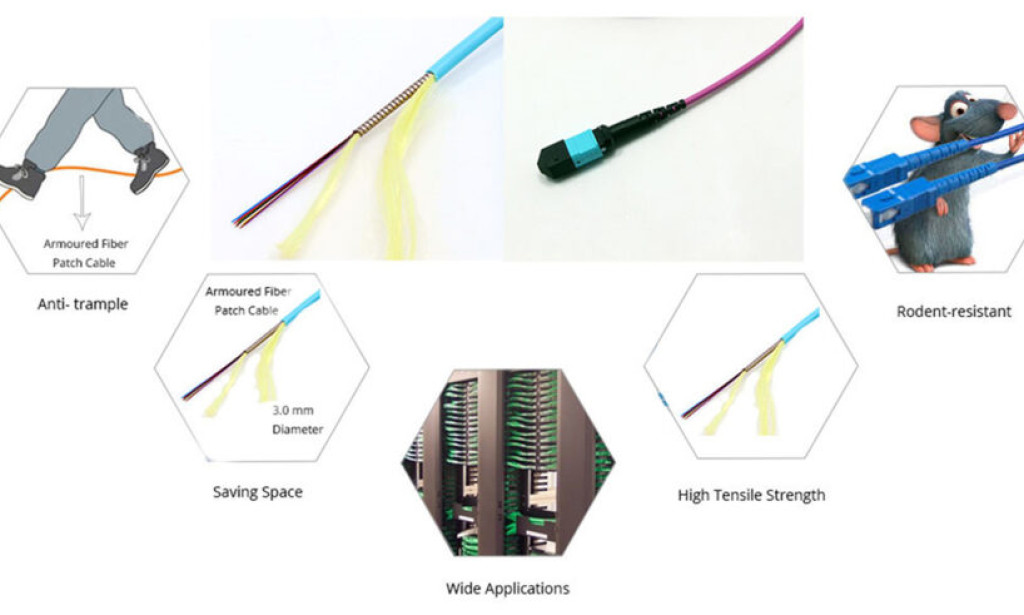
Common Causes of 12F MPO Trunk Cable System Problems
The problems that affect installed 12F MPO trunk cable systems can be broadly categorized into connector contamination issues, physical cable damage problems, polarity errors, and performance degradation from component aging or mechanical stress.
Connector contamination is the most common cause of degraded optical performance in MPO fiber systems. The twelve fiber end faces in each MPO connector provide twelve opportunities for contamination to cause insertion loss problems or complete link failures. Contamination can enter an MPO connector through several mechanisms including removal of protective caps in dusty environments, contact of the end face with contaminated hands or tools, and migration of contamination from mated connectors during the mating process.
Physical cable damage can occur during installation if cables are bent below their minimum bend radius, subjected to excessive pulling tension, or pinched between cable management components. Post-installation damage can result from inadvertent mechanical contact with the cable in areas where cable management does not provide adequate protection. Damage to the 12F MPO trunk cable jacket or internal fiber structure causes increased attenuation or complete fiber breakage that affects the optical performance of the affected channels.
Polarity errors in the initial installation are a common cause of link failures that can be difficult to diagnose without appropriate test equipment and documentation. A polarity error does not cause increased insertion loss on the affected fibers but prevents the network equipment from establishing a link because transmit and receive fibers are connected to incorrect ports. In complex 12F MPO trunk cable systems with multiple connection points, polarity errors can be particularly difficult to trace without systematic documentation of the intended and actual polarity at each connection.
Systematic Troubleshooting Approach
A systematic troubleshooting approach applied consistently to 12F MPO trunk cable problems reduces the time required to identify root causes and ensures that problems are fully resolved rather than temporarily masked.
The first step in any troubleshooting process is gathering information about the problem. Determine which specific fiber channels or links are affected, when the problem first appeared, what changes if any were made to the cabling system before the problem appeared, and whether the affected channels have ever worked correctly. This information narrows the range of possible causes and guides the direction of the investigation.
Visual inspection of the affected 12F MPO trunk cable connections is the next step. Inspect all MPO connectors associated with the affected channels for obvious damage to the connector housing, contamination visible on the end face, incorrect connector orientation, and proper seating of the connector in its mating adapter. Many problems are identifiable through visual inspection without requiring test equipment.
End face inspection using a fiber optic inspection microscope or video inspection probe should be performed on every connector associated with the affected channels. The inspection should cover all twelve fiber end faces in each MPO connector, checking for particle contamination, oil or organic contamination, scratches, chips, or cracks in the fiber end face. Any contamination found should be carefully cleaned using appropriate MPO cleaning tools before retesting.
Interpreting Test Results for Fault Location
When visual inspection does not identify the cause of a 12F MPO trunk cable problem, optical testing provides the quantitative measurements needed to locate and characterize the fault.
Insertion loss measurements that show excessive loss on specific channels but not others within the same MPO connector suggest connector-level problems rather than cable-level problems. The contamination, damage, or alignment problem causing excessive loss is likely localized to the specific fibers showing elevated loss rather than being a systematic issue affecting all channels in the connector.
OTDR measurements of affected channels in a 12F MPO trunk cable system can locate the position of faults along the fiber with good accuracy. A fault location that corresponds to a known connection point suggests a connector problem at that location. A fault location that does not correspond to any connection point suggests physical cable damage at that location, which requires cable replacement to resolve.
Conclusion
Effective troubleshooting of 12F MPO trunk cable system problems requires a systematic approach that combines information gathering, visual inspection, end face cleaning, and optical testing to identify root causes and implement appropriate solutions. Maintaining the cleanliness of all MPO connectors, protecting cables from mechanical damage, and keeping accurate as-built documentation that facilitates efficient problem diagnosis are the most effective strategies for minimizing both the frequency and the impact of MPO system problems. OMC FTTH provides technical support resources to help customers effectively diagnose and resolve issues with their installed MPO cabling infrastructure.

You must be logged in to post a comment.